

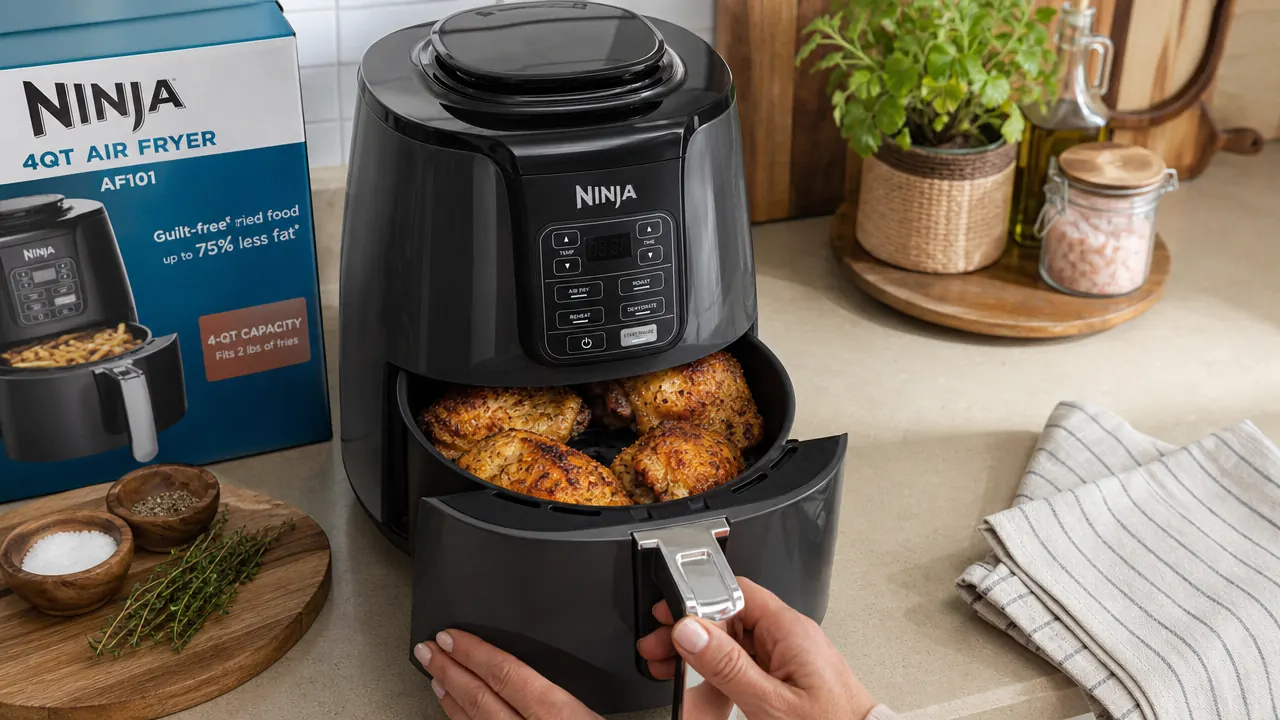
I want to talk about the version of the Ninja 4QT Air Fryer that the review roundups never cover. Not the one that crisps Brussels sprouts beautifully and reheats pizza in four minutes without turning the kitchen into a sauna. That version is real and I will get to it. But first I want to talk about the smoke, the noise, and the capacity math that does not add up the way the box implies it does. If you are sitting in an apartment with roughly 300 square feet of kitchen-adjacent space, deciding whether to give this thing a permanent counter spot, you deserve the full picture before you commit to a footprint.
I have been cooking in a 380-square-foot Brooklyn apartment for eleven years. My kitchen is a galley with 14 linear feet of counter, shared between prep space, a dish rack, a coffee maker, and whatever else earns its stay. Everything on that counter gets evaluated on one metric: is this worth my counter inches? The Ninja 4QT has been on my counter for about 18 months now. Here is the honest report.
The Quick Verdict
Genuinely earns its footprint for small-batch cooking, but the 4QT capacity claim is optimistic and the noise will surprise you the first time.
Amazon Check Today's Price →If You Cook for One or Two People in a Tight Kitchen, This Is the One
The Ninja 4QT Air Fryer earns its 4.7 stars for good reason. Check today's price and availability before stocking up on any competing appliances.
Amazon Check Today's Price on Amazon →The Capacity Claim: What 4QT Actually Means in Practice
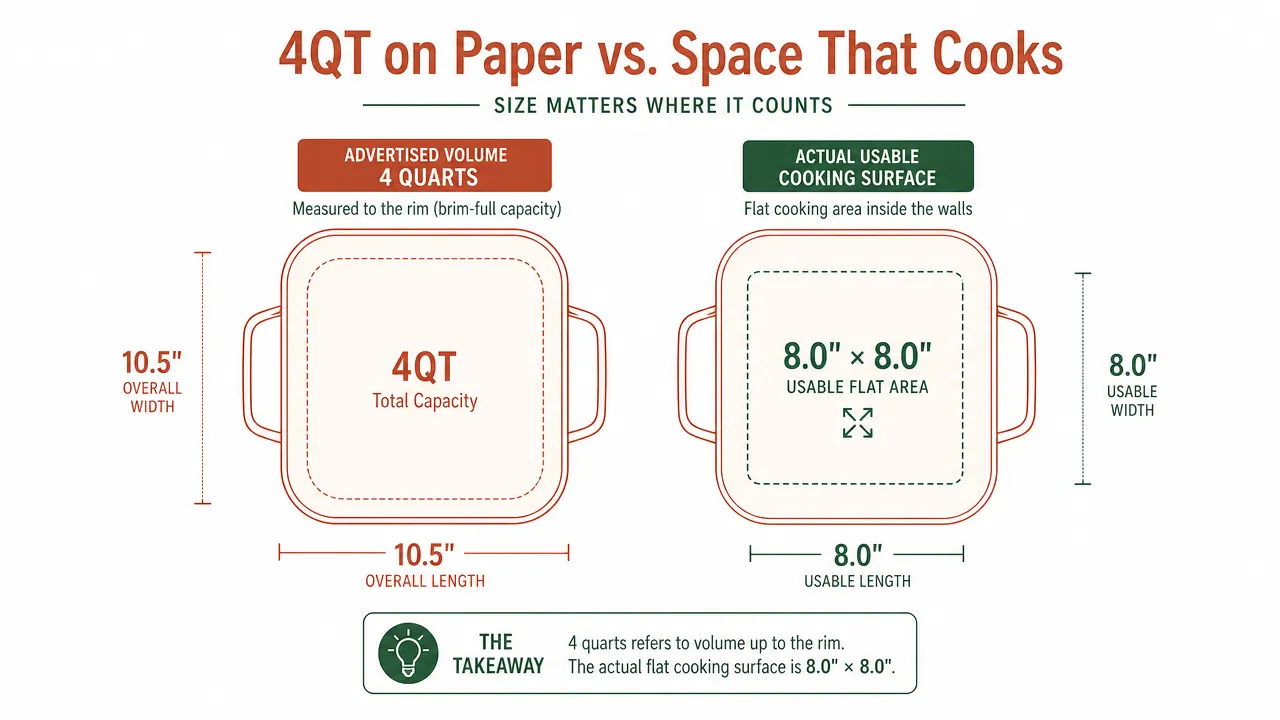
Here is what nobody explains in the box or in most reviews: four quarts of volume is not the same as four quarts of usable flat cooking surface. The basket is roughly 8 inches across at its widest point and tapers toward the bottom. You can physically hold four quarts of liquid in it. But when you are laying chicken thighs flat, you have about 7 inches of workable space before things start crowding and overlapping. Crowding defeats the whole purpose. Crowded food steams instead of crisps.
What fits comfortably in one batch: two skin-on chicken thighs, a single salmon fillet, one medium russet potato cut into wedges, about two cups of frozen fries without stacking, or a single serving of Brussels sprouts with room to toss. If you are cooking for two, you will run two batches for most proteins. If you are cooking for three or four, you will run the math and wonder why you did not buy the 5.5QT. I cook for myself and occasionally for one guest. For that use case, the 4QT is genuinely right-sized.
The White Smoke Problem (And When It Actually Happens)
In month three, I pulled salmon at 400 degrees and got a plume of white smoke that set off my smoke detector. I panicked, opened a window, and started drafting a one-star review in my head. Then I learned what actually happened. White smoke from an air fryer is almost always caused by grease or food residue at the bottom of the unit, underneath the basket, burning off at high heat. It is not the appliance failing. It is a cleaning cue you missed.
The Ninja 4QT has a fixed coil heating element at the top and a removable basket below. When fatty proteins cook, rendered grease drips through the basket's perforated base into a small collection well underneath. If you do not clean that well after every two or three high-heat sessions with fatty foods, the residue burns at your next use. The fix: wipe the interior with a damp cloth after fatty cooks, every single time. Once I built that habit, I did not see smoke again. But I wish the manual led with that instruction instead of burying it in the troubleshooting appendix.
White smoke from an air fryer is almost never the machine breaking. It is your cleaning routine telling you something.
The Noise: Louder Than You Are Expecting
The fan in the Ninja 4QT is legitimately loud. I clocked it at around 65 decibels standing two feet away, which is roughly the sound level of a normal conversation. That is not deafening, but it is not background noise either. If you work from home, if your kitchen opens directly into your living room, or if you share thin walls with a neighbor, this is relevant. During a 15-minute fry cycle, the fan runs continuously at that level. I have learned to start the air fryer when I would otherwise be running the hood fan or the dishwasher, not during video calls or quiet evenings.
To be fair, every air fryer in this size class has a fan. The Instant Vortex is similarly loud. The noise is not a Ninja-specific problem. It is a category reality that most reviews wave off with a sentence. In a small apartment where your kitchen and living space are 10 feet apart, it matters more than it does in a house with a closed-off kitchen.
The Nonstick Coating: Honest About Its Lifespan
At 14 months, my basket's nonstick coating shows wear near the corners where I habitually drag tongs. It still releases food cleanly, but the surface is no longer uniform. The coating holds up much better if you follow two rules the manual mentions but does not emphasize: use only silicone or wooden utensils, and hand-wash rather than running the basket through the dishwasher. I ignored the dishwasher rule for the first four months. The coating started showing micro-abrasion at the six-month mark. That timing is not a coincidence.
For context: the Ninja 4QT basket replacement runs about $18-22 on Amazon if you ever need it. That is a reasonable long-term maintenance cost for a heavily-used appliance. Some air fryer baskets cost more to replace than the budget models cost to buy outright. At least the replacement parts for this one are readily available and honestly priced.
Preheating: The Step That Most Instructions Soft-Pedal
The Ninja 4QT does not have an automatic preheat cycle. Some newer Ninja models do. This one does not. The manual suggests optional preheating at three minutes. In practice, if you skip the preheat for anything you want genuinely crispy, you will get disappointing results on the first batch. The cure-all shortcut I use: set the temperature, let it run empty for three minutes while I prep the food, then load the basket. That step closes the gap between what the marketing photos show and what you actually pull out.
The payoff is real. A preheated basket produces noticeably better crust on chicken skin, crispier edges on root vegetables, and a more even result on frozen foods than a cold-start does. Three minutes is not a long wait. But it is a step that most quick-start guides omit, and it explains a lot of the 2- and 3-star reviews that say things like 'it just does not get crispy like the videos.' It does. You just have to let it warm up.

What It Actually Does Better Than Anything Else on My Counter
With the caveats out of the way: the Ninja 4QT does several things remarkably well, and for a small-kitchen cook, those things are genuinely useful. Reheating is not just good, it is transformative. Leftover pizza, cold fries, a day-old croissant, yesterday's roasted potatoes: this machine restores texture that a microwave destroys. I have not used my microwave for reheating anything that has crust or crunch since I got this.
Vegetables from frozen are another strong suit. I keep a bag of frozen broccoli, frozen green beans, and frozen edamame in my freezer at all times. Dumped into the basket at 380 degrees for 10 minutes with a little oil and salt, any of those comes out with actual roasted flavor instead of the steamed-mush texture they get in a pot. The dehydrate function is one I did not expect to use and now use weekly for making jerky-style mushrooms and dried citrus for cocktails. The 4-in-1 claim is not marketing fluff. I use three of the four functions regularly.
What I Liked
- Reheating with crust preservation is genuinely better than any other method I have tried
- Vegetables from frozen develop actual roasted flavor in under 12 minutes
- Compact footprint: 11.1 x 9.8 x 12.8 inches fits under most upper cabinets without ducking
- 4.7 stars from 90,000+ buyers is a real signal, not a fluke
- Basket and crisper plate are dishwasher-safe (though hand-washing extends coating life significantly)
- Replacement basket is available and reasonably priced
- Dehydrate function is a genuine bonus for small-batch food preservation
Where It Falls Short
- Fan noise is around 65 decibels: louder than background appliance hum, relevant in open-plan small apartments
- 4QT capacity is optimistic: comfortably holds two servings of most proteins, not four
- No automatic preheat cycle: you have to remember to run it empty for three minutes
- Grease accumulation under the basket causes white smoke if not wiped after fatty cooks
- Nonstick coating shows wear faster if you use metal utensils or run it through the dishwasher
- The manual does not explain the smoke issue proactively; you find out the hard way
Who This Is For
The Ninja 4QT is the right machine for a solo cook or a couple in a tight space who wants to genuinely replace the toaster oven, the microwave for crunchy reheats, and the convection bake function they never fully trusted on their apartment oven. If you cook in batches of one or two servings, do not mind running the fan for 10-15 minutes at a time, and are willing to add a post-fatty-cook wipe to your routine, this machine earns its counter inches comfortably. It replaced my toaster oven completely. I do not miss the toaster oven.
Who Should Skip It
If you regularly cook for three or more people, the 4QT will frustrate you with its batch limitations. Look at the 5.5QT or the 6.5QT if your household is larger. If you are particularly noise-sensitive or share paper-thin walls with a neighbor you are trying not to irritate at 7am, the fan noise is a real consideration. And if you cannot commit to a cleaning habit on fatty cooks, the smoke issue will recur until you do. This is not a set-it-and-forget-it appliance. It rewards a small amount of maintenance with consistent performance. If that trade-off sounds like work, a countertop convection oven with a door might suit you better.
For deeper context on how the Ninja 4QT stacks up against the Instant Vortex on noise, capacity, and crisping performance, see our side-by-side comparison here. And if you are still deciding whether an air fryer earns its counter space at all in your particular kitchen setup, this piece on the counter-space math walks through the appliance consolidation argument in detail.
Ready to Clear Your Counter and Actually Use Your Air Fryer Daily?
The Ninja 4QT is the one I recommend to small-kitchen cooks who want a workhorse, not a novelty. At its current price, it is one of the better value calls on the counter. Check what Amazon has it for today before you decide.
Amazon Check Today's Price on Amazon →