
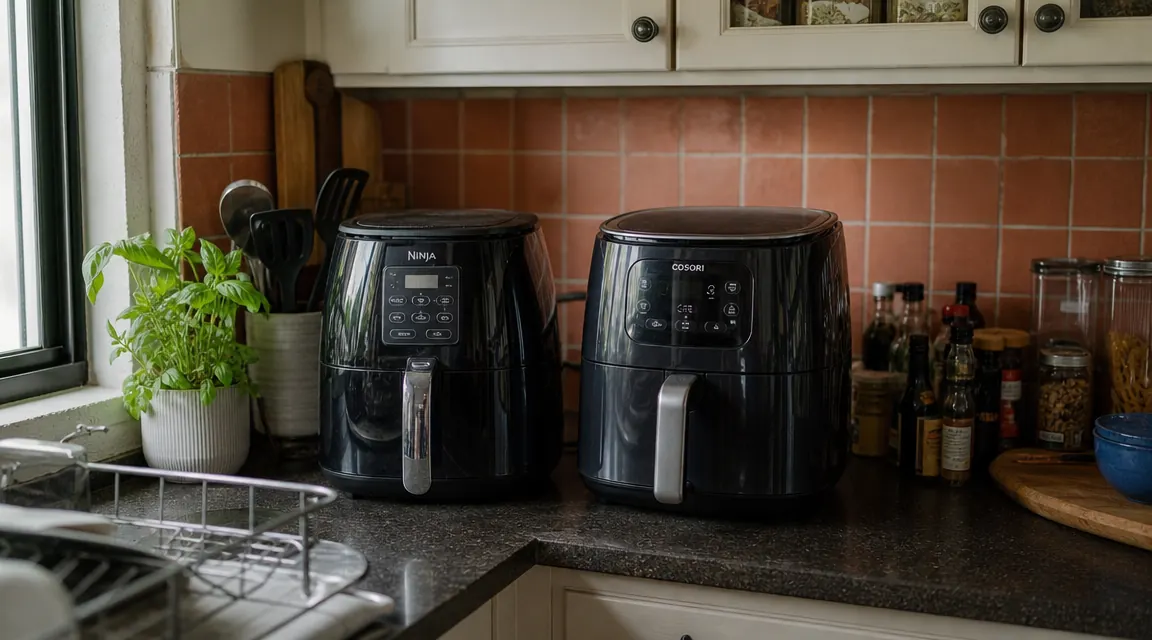
My Brooklyn kitchen gives me approximately 14 usable inches of counter depth between the backsplash and the edge. Two spots that stay permanently occupied: a coffee maker on the left, a small cutting board on the right. Every other appliance has to justify its rent before it gets a permanent address on my counter. So when I decided to add an air fryer, the first question was not which one cooks better. It was: which one is actually sized for the way I live?
The Ninja AF101 4QT and the Instant Vortex 4QT are the two models I see most in small-kitchen recommendations. Both are marketed at the same audience, both claim a compact footprint, and the price gap between them is roughly $20 to $30 depending on the day. That is close enough to make the choice genuinely interesting. I borrowed a Vortex from my neighbor Theresa on the third floor and ran both machines side by side for three weeks. Here is what actually separates them.
| Spec | Ninja AF101 4QT | Instant Vortex 4QT |
|---|---|---|
| Price (current) | ~$89.99 | ~$59.99–$69.99 |
| Footprint (W x D) | 8.3 in x 10.8 in | 8.7 in x 11.8 in |
| Height | 12.0 in | 12.2 in |
| Basket capacity | 4 quarts | 4 quarts |
| Wattage | 1550W | 1500W |
| Functions | 4 (Air Fry, Roast, Reheat, Dehydrate) | 4 (Air Fry, Roast, Bake, Reheat) |
| Preheat required? | Optional (preheats in ~3 min) | Optional (preheats in ~2 min) |
| Basket release | Single-button release | Press-in handle release |
| Weight | 7.9 lbs | 8.6 lbs |
| Warranty | 1 year | 1 year |
Where the Ninja Wins
The crisp factor is real and it is measurable. I ran the same test three times with each machine: a single layer of frozen sweet potato fries, 400 degrees, 14 minutes, no shake. The Ninja came out evenly browned across the basket. The Vortex had noticeably darker edges and a softer center. That tells me the Ninja's heating element distributes more evenly, which matters most when you are cooking a full basket. At 4 quarts you are often pushing capacity.
The footprint difference is small but real. The Ninja is half an inch narrower and a full inch shallower than the Vortex. That does not sound like much until you are working with 14 inches of usable depth. The Ninja fits. The Vortex technically fits but you lose about an inch of breathing room at the front. In a tight kitchen, that inch is the difference between comfortable and annoying. If your counter depth is the constraint, the Ninja wins on math alone.
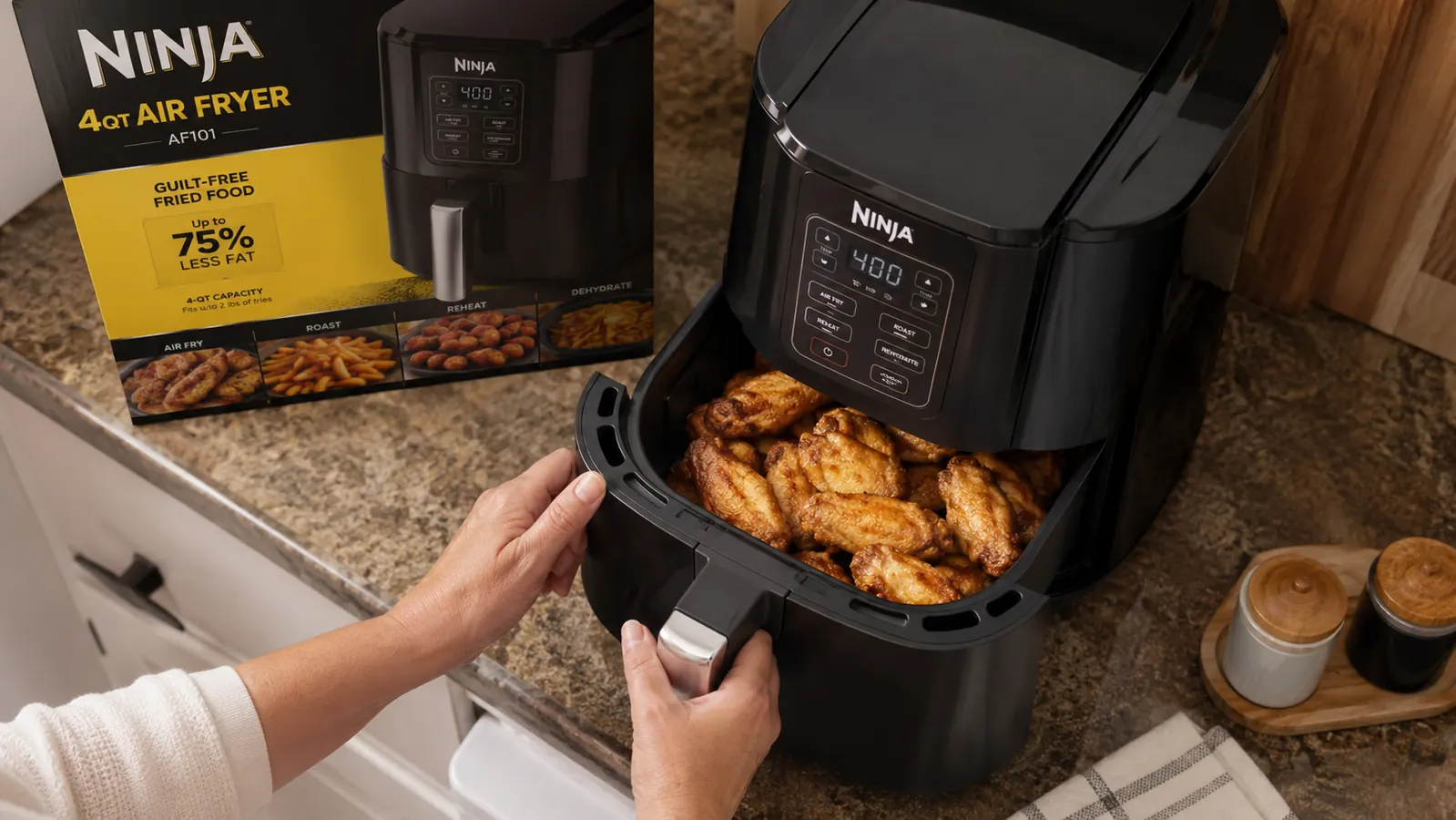
The basket mechanism on the Ninja is also simpler. The single-button release drops the insert, the basket has a wider mouth, and cleanup takes me about 90 seconds. The Vortex uses a press-in handle release that I found slightly fiddly the first few times, and the basket opening is fractionally narrower. For daily use neither is a dealbreaker. But the Ninja is just marginally less annoying at 6:45 on a Tuesday morning when you are reheating last night's chicken.
Where the Instant Vortex Wins
Price is the obvious one. The Vortex regularly lands $20 to $30 below the Ninja, and sometimes more. If your budget is tight and you are buying your first air fryer, that gap matters. The Vortex is not a worse machine because it costs less. It cooks well. It handles frozen snacks, reheated leftovers, and roasted vegetables without complaint. The crispiness gap I described above only becomes obvious when you are doing full-basket loads. For someone cooking single portions or small batches, the Vortex performs close enough that the price difference is hard to justify.
The Vortex also includes a Bake function where the Ninja offers Dehydrate instead. If you ever want to bake small items like muffins or corn bread in your air fryer, the Vortex gives you a dedicated setting calibrated for that. The Ninja's dehydrate mode is genuinely useful for making jerky or fruit chips overnight, but it is a narrow use case. If you bake more than you dehydrate, the Vortex function lineup is more practical for your cooking style.
If the Ninja's footprint edge matters to you, check today's price before the gap changes.
The Ninja AF101 4QT is the more compact of the two. Right now it carries a 4.7-star average from over 90,000 reviews. Pricing shifts frequently, so it is worth checking what it is running today.
Amazon Check Today's Price on Amazon →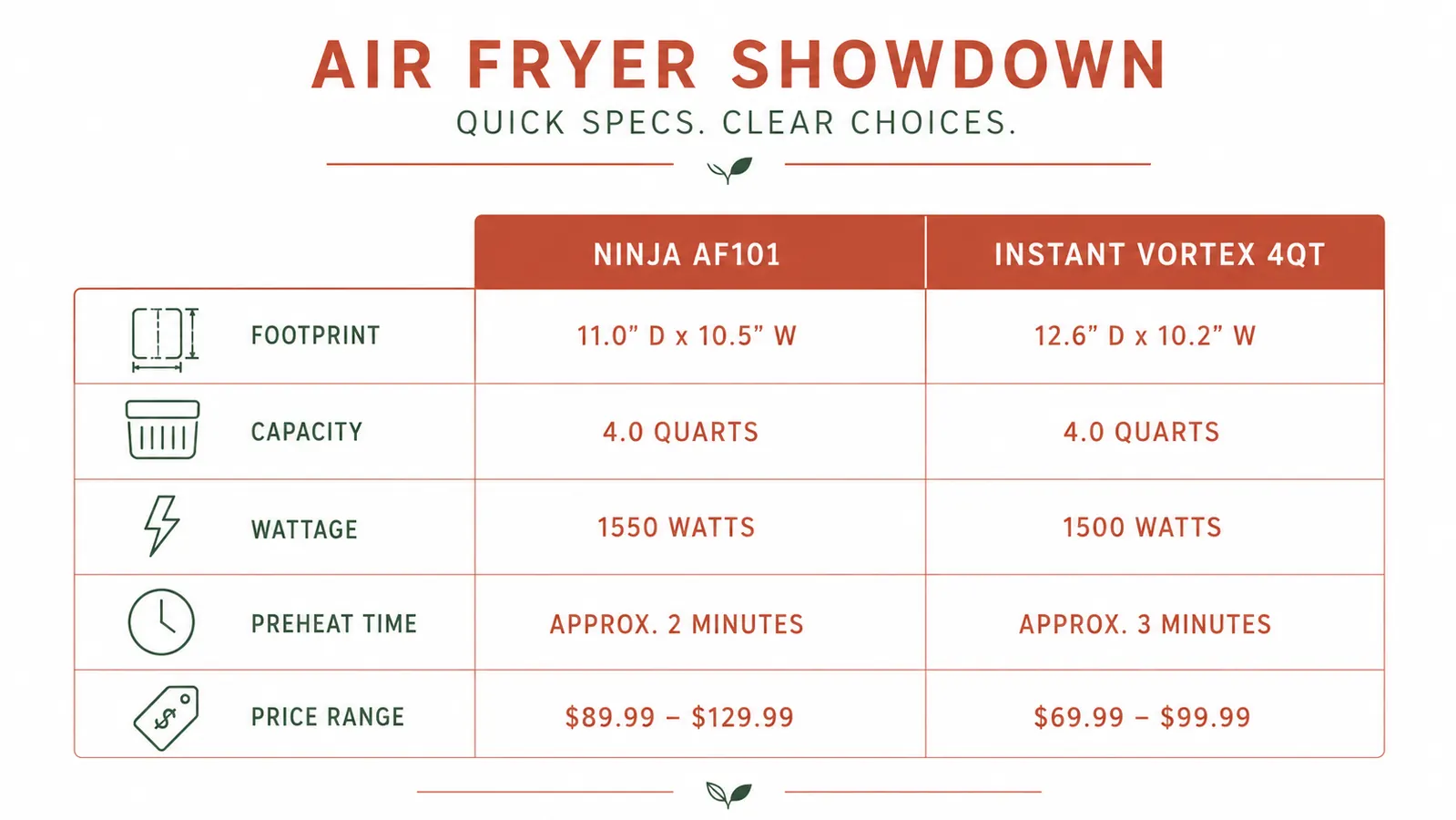
Counter Footprint: The Real Test for Small Kitchens
Here is the thing about footprint comparisons: the specs on paper are one thing, but the physical reality in your kitchen is another. I measured both machines against my counter twice. The Ninja measures 8.3 inches wide by 10.8 inches deep. The Vortex is 8.7 by 11.8. Neither number alone seems alarming. But the Vortex sticks out a full inch further from the backsplash, and in my kitchen that inch hangs over the edge of the counter when I place it in the only spot where it fits. That is a safety concern for a machine that runs at 1500 watts.
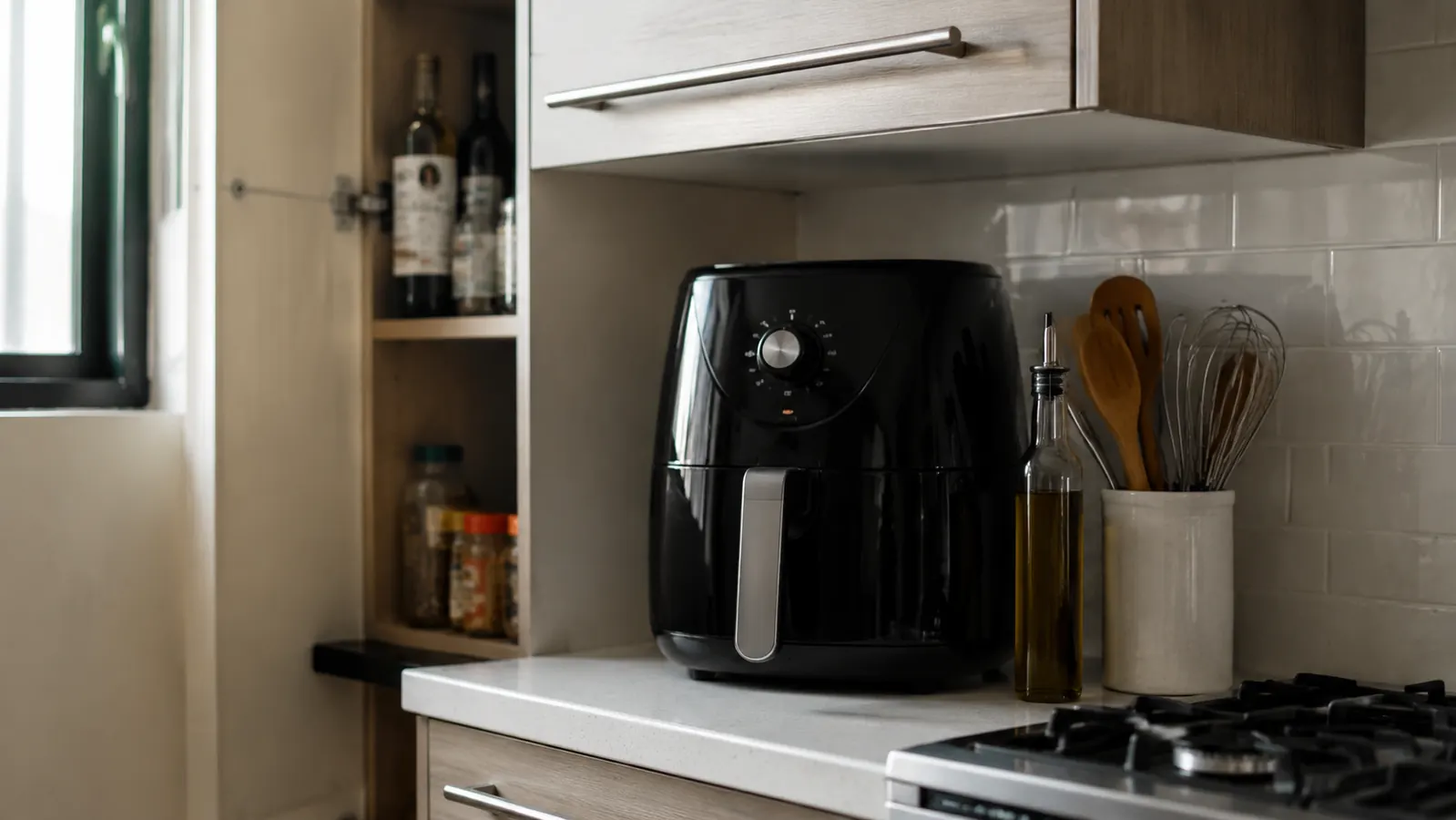
Height is almost identical at 12 inches versus 12.2 inches. Both machines clear the standard 18 inches of clearance under upper cabinets without issue. Neither requires you to pull them out from under the cabinets to use them, which matters for day-to-day convenience. One less reason to avoid using the machine is one more reason it earns its counter inches.
In a kitchen where every inch of counter has a job, the machine that is slightly smaller is not just more convenient. It is safer, and it stresses you out less every time you cook.
Cooking Performance Across Real Tasks
I put both machines through the same five tasks over three weeks: frozen fries, reheated pizza, roasted broccoli, chicken thighs from raw, and homemade kale chips. On three of the five tasks, I preferred the Ninja results. The frozen fries were crisper and more evenly browned. The chicken thighs finished at the same internal temperature but had a better exterior texture. The kale chips, which are sensitive to uneven heat, came out crispier without burning on the edges.
The Vortex matched the Ninja on reheated pizza, which is the task I do most often. Both machines hit the right balance of re-crisped crust without drying out the cheese. For roasted broccoli the Vortex was slightly softer overall, though I could get the same result by adding two minutes to the cook time. If your primary use case is reheating leftovers and roasting vegetables, the Vortex performs well enough that paying more for the Ninja is optional. If you care about the best possible crisp on fried foods, the Ninja is noticeably better.
Noise, Smell, and Cleanup
Both machines are roughly equivalent in sound level. Neither is quiet but neither is loud enough to drown out a podcast from across the kitchen. The Ninja has a slightly lower pitch to its fan noise, which I find less fatiguing during longer cook cycles. The Vortex has a higher-pitched hum. This is subjective and unlikely to drive your decision.
New plastic smell on first use: both machines produce it, and both clear out by the second or third use. The Ninja's smell dissipated faster in my experience, but I cannot say whether that reflects better materials or just a unit-to-unit difference.
Cleanup goes to the Ninja. The basket releases cleanly with one button, the surfaces are nonstick and food-release is reliable, and I have never needed to soak it. The Vortex basket is also nonstick but the handle release mechanism creates one more surface where grease accumulates. It is not a significant difference for weekly cleaning but it adds up over months of daily use.
Who Should Buy Which
Buy the Ninja AF101 if your kitchen counter depth is under 14 inches, if you cook full-basket loads regularly, or if you fry foods and care about consistent crispiness. The smaller footprint, the better heat distribution at capacity, and the cleaner basket mechanism all add up to a machine that earns its counter inches more convincingly. At a 4.7-star average across over 90,000 reviews, the rating reflects a genuine track record, not a promotional push. The Ninja costs more but it is the version I would reach for again.
Buy the Instant Vortex if you are on a tighter budget, if you primarily reheat leftovers and roast vegetables rather than fry foods, or if you want a Bake function instead of Dehydrate. The Vortex is not a bad machine. It does the job it promises. If you are new to air frying and unsure whether you will use the machine daily, spending $30 less to test the habit makes sense. You can always upgrade later once the air fryer has proven itself in your routine.
For any small kitchen where counter space is the primary constraint and daily cooking is the primary use case, I lean Ninja. The half-inch width and full-inch depth savings are real advantages, not marketing language. When you live with those numbers every day, they feel significant.
The Ninja AF101 is the smaller machine with the better crisp. Worth seeing today's price.
If you are cooking in a small kitchen and want an air fryer that earns its footprint, the Ninja 4QT is the one I keep on my counter. Over 90,000 reviewers agree it is reliable. Check today's price and availability on Amazon.
Amazon Check Today's Price on Amazon →