
Two years ago I measured my available counter width before buying a coffee maker. That sentence tells you everything about how I cook and what I prioritize. My Brooklyn apartment kitchen is roughly 7 feet of usable counter run, shared between a toaster oven, a dish drying rack, a cutting board that never gets put away, and the coffee setup. When I decided my old 12-cup drip machine was taking too much real estate for one person who drinks one cup each morning, I started looking at single-serve options. The Keurig K-Mini was 5 inches wide. I bought it the same day I found that out.
That was November 2023. It is now two full years of daily use, through two apartment sublets, a kitchen renovation that exiled me to a mini-fridge situation for six weeks, and a period where I was going through K-Cups at an embarrassing rate. I have opinions. Here they are.
The Quick Verdict
The best small-kitchen coffee maker for people who drink one cup a day and genuinely cannot afford the counter inches for anything bigger. The brew quality is decent, not outstanding. The size is genuinely unmatched.
Amazon Check Today's Price →If counter space is your main constraint, nothing comes close to 5 inches wide
The Keurig K-Mini has 4.3 stars across over 107,000 reviews. It brews 6 to 12 oz per cup, stores just a single pod at a time, and fits into gaps other machines cannot. Check today's price before it shifts.
Amazon Check Today's Price on Amazon →How I've Used It
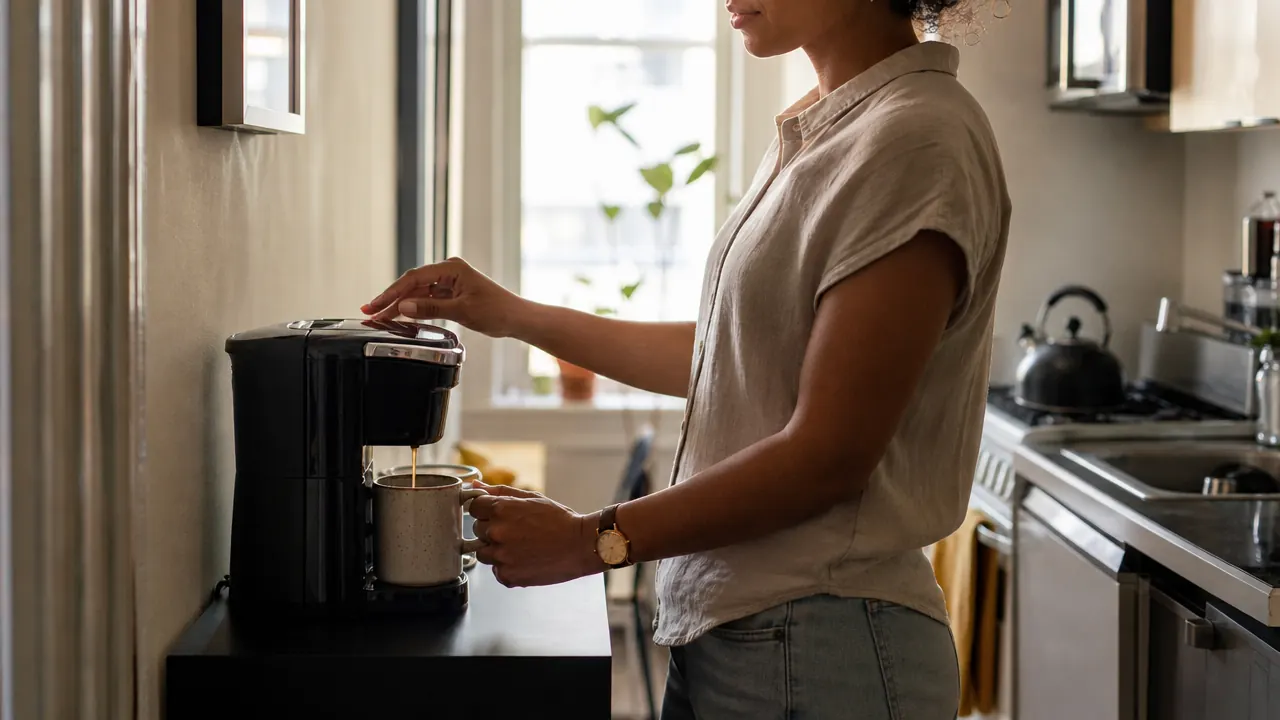
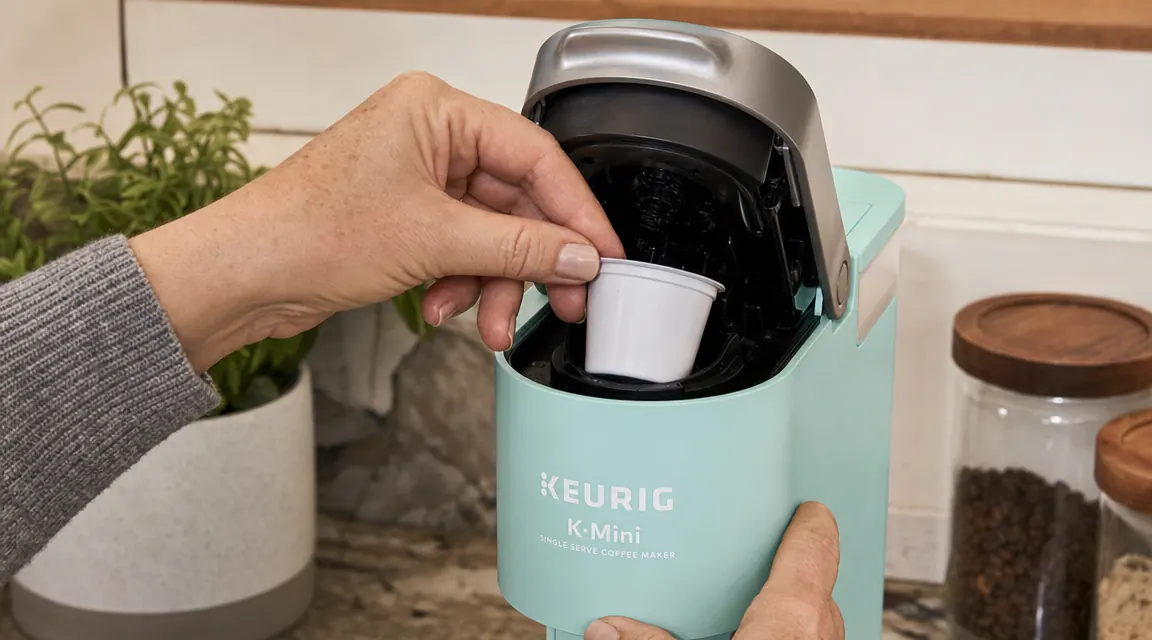
My daily routine: wake up, fill the removable water reservoir (it holds exactly one travel mug worth, which took some adjusting from the old fill-and-forget drip machine behavior), drop in a K-Cup, press the button. Thirty seconds later, coffee. On weekdays I brew one 10 oz cup. On weekends sometimes two back-to-back, which means two separate fill-and-brew cycles since the reservoir only holds enough for one serving at a time.
That single-serve reservoir is the defining characteristic of this machine, not the footprint. The footprint is what makes you buy it. The per-cup-fill workflow is what changes how you live with it. I will get into the tradeoffs of that shortly. But first: after two years I can confirm the machine has never broken down, never leaked, never done anything alarming. It just makes coffee every single day without complaint.
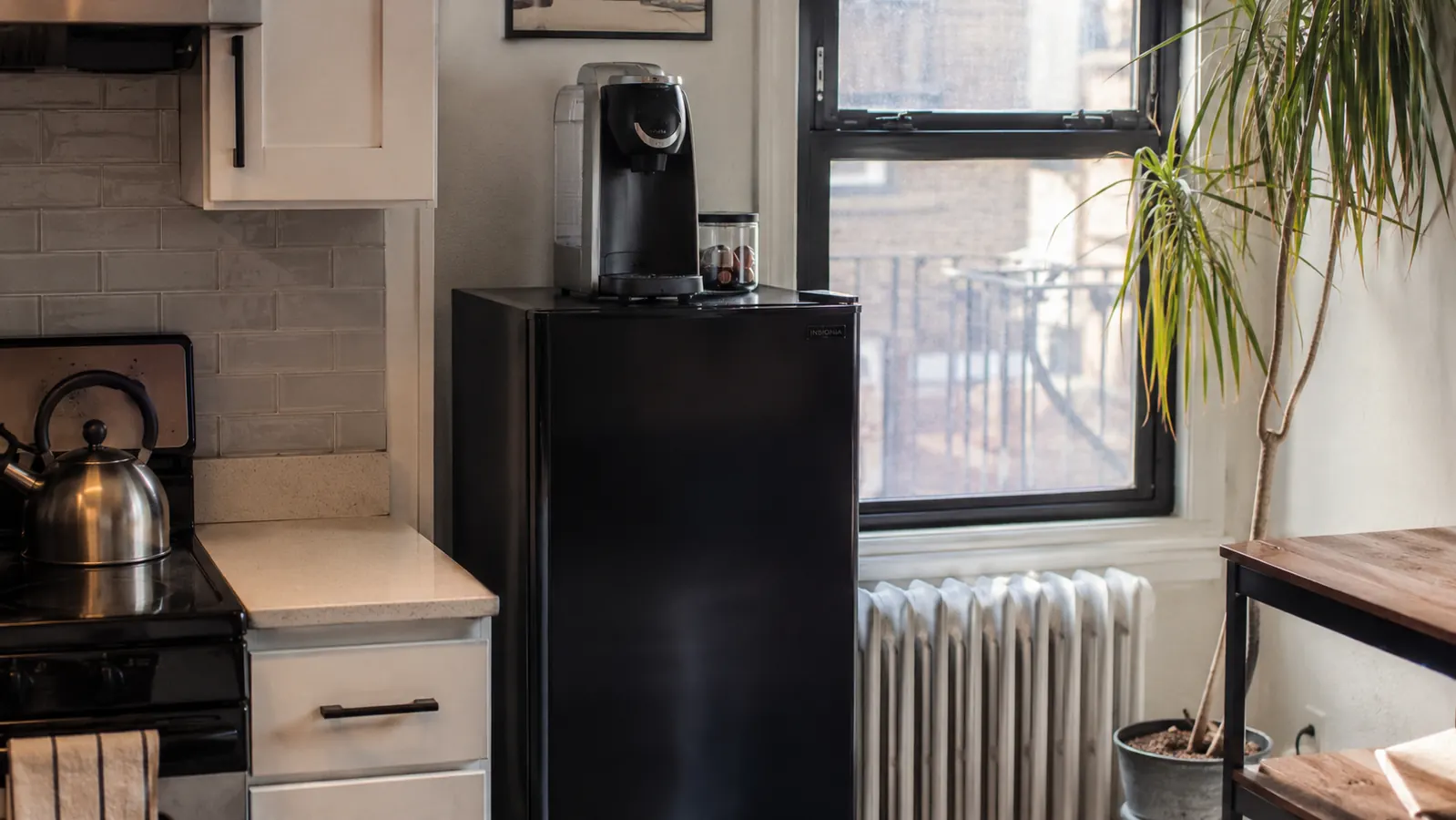
I have run it on four different countertop surfaces: laminate, butcher block, tile, and the top of a mini-fridge during the renovation period. It sits flat and stable on all of them. The cord length is 22 inches, which is tight. In one of my sublet situations the only outlet was on the wrong wall and I needed an extension cord. Keep that in mind when you are planning placement.
The Footprint Question, Actually Answered
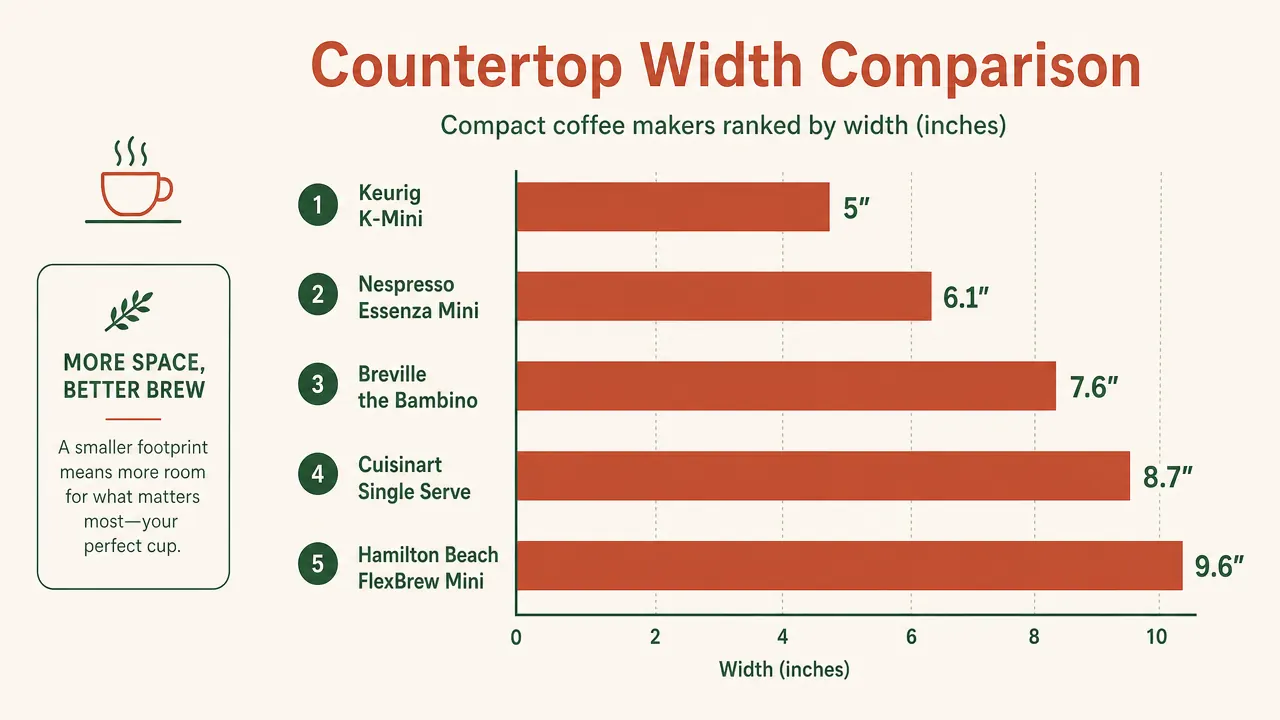
Five inches wide. That is the number that sells this machine to small-kitchen cooks, and it holds up. I measured it against every other machine I considered. The next closest was a Nespresso Vertuo Pop at 5.1 inches wide but 11.6 inches deep versus the K-Mini's 11.3 inches deep. In a corner situation, depth matters as much as width. The K-Mini is the most spatially efficient single-serve machine you can buy right now without spending significantly more or compromising to a machine with a worse reliability track record.
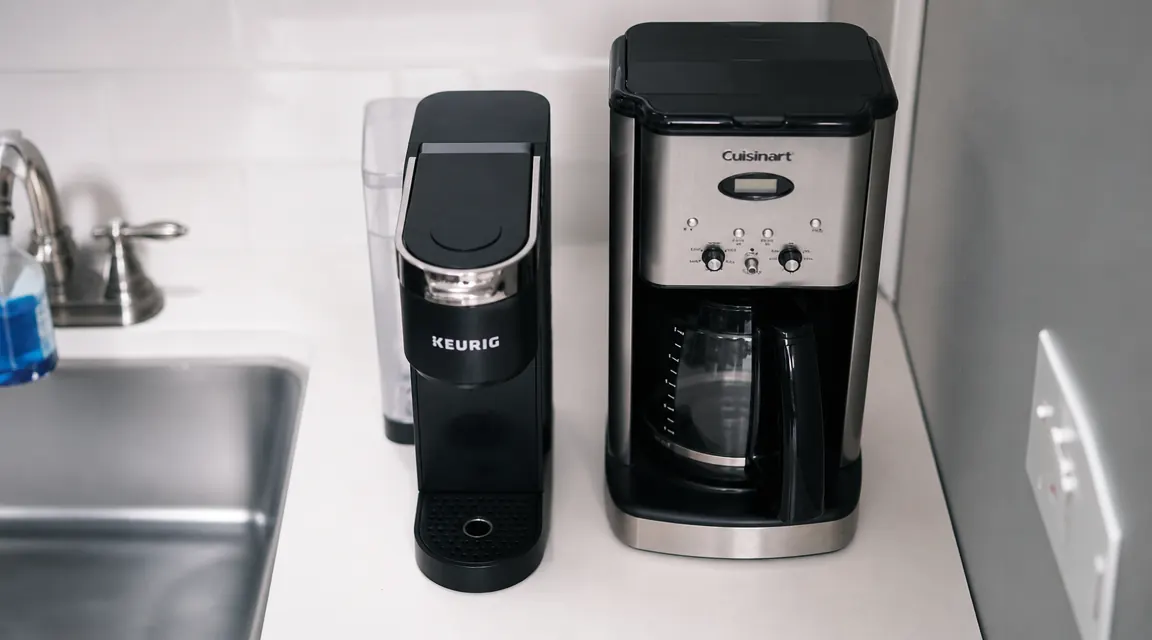
For reference: a standard 12-cup drip coffee maker runs 8 to 10 inches wide and 13 to 16 inches deep. That is a coffee table's worth of counter in a small kitchen. My old Cuisinart was 9 inches wide. Getting rid of it and replacing it with the K-Mini was like gaining a small cutting board's worth of working space. It sounds minor. In a 7-foot galley kitchen, it is not minor.
Getting rid of my drip machine and replacing it with the K-Mini was like gaining a small cutting board's worth of working space. In a 7-foot galley, that is not minor.
Brew Quality: Honest Assessment
The K-Mini brews at around 192 degrees Fahrenheit. Specialty coffee people will tell you that is under the ideal range of 195 to 205. They are right, and if you are a pour-over purist who grinds single-origin beans every morning, this is not your machine and a review site for small-kitchen appliances is not where you should be making this decision.
For the rest of us: the coffee tastes like K-Cup coffee. Which is to say it tastes fine. The flavor depends almost entirely on which pod you use. I have gone through Green Mountain Breakfast Blend, Dunkin' Original, Starbucks Pike Place, and a rotating cast of whatever was on sale. The machine delivers those pods' flavors accurately and consistently. The cup I brewed on day one tastes the same as the cup I brewed last Tuesday.
Brew size matters here. The 6 oz setting produces a noticeably stronger, more concentrated cup. The 12 oz setting produces something closer to a lighter diner-style coffee. I settled on 10 oz as my daily setting after about a month of experimenting. One thing the machine cannot do is a true espresso. If you are expecting espresso, you want a Nespresso. The K-Mini is a brewed-coffee machine that brews in small, convenient portions.
Two Years of Pod Costs: The Real Math
This is the conversation nobody has in coffee maker reviews but everyone needs to have. K-Cups at a reasonable price point run about 50 to 70 cents per pod if you buy in bulk on Amazon. If I brew one cup a day, that is roughly $180 to $255 per year in pods. My old drip machine used ground coffee and produced 6 to 8 cups per brew, which I mostly poured down the drain. The actual per-cup pod cost, once I stopped throwing away half a pot of coffee, ended up comparable.
The calculus changes if you drink three or four cups a day, or if you have a partner who also wants coffee at different times. In those cases, a mid-size drip machine might be cheaper to run. But if you are a one-cup-in-the-morning person living alone, the pod economics make more sense than most people assume. Also: I use a reusable K-Cup filter for about half my brews now. Ground coffee works fine in it and costs significantly less per cup. The machine handles it without any issue.
What I Wish I Had Known Before Buying
The reservoir situation. I want to be direct about this: you fill the reservoir for every single cup. There is no tank that holds 40 oz of water so you can set it and forget it for a week. The K-Mini holds one cup's worth of water, period. You fill it, you brew, you do it again tomorrow. For people who prioritize convenience over counter footprint, this is where the K-Mini starts to feel frustrating. If forgetting to fill it the night before means you are bleary and impatient at 6 a.m. trying to get water into a narrow reservoir, that is a real quality-of-life issue.
I adapted. I keep a small pitcher next to the machine now. I fill the pitcher each evening and pour from it in the morning. It adds one step but eliminates the fumbling-with-the-faucet problem. It also means I know exactly how much water I am putting in, which is useful.
The other thing I wish someone had told me: the machine has no built-in clock, no auto-on, no brew scheduler. If you are the kind of person who wants to walk into the kitchen and find your coffee already made, this machine will not do that. It is manual start every time. That is a deliberate design trade-off that makes the machine smaller. I accepted it. But it is worth knowing.
What I Liked
- 5-inch width is genuinely the smallest footprint of any reliable single-serve machine available
- Brews 6 to 12 oz with a single button press, fast and consistent
- Removable reservoir makes cleaning easy and honest
- Handles reusable K-Cup filters without any modification needed
- Extremely reliable over two years of daily use
- Compatible with the entire K-Cup ecosystem, thousands of pod options
Where It Falls Short
- Per-cup reservoir fill is a workflow change that some people find genuinely annoying
- No water tank, no auto-brew, no scheduling features
- Brew temperature runs slightly below the specialty-coffee ideal range
- Cord is short at 22 inches, outlet placement matters
- No frother, no milk steaming, no espresso, does one thing only
Who This Is For
You drink one cup of coffee in the morning, maybe two on weekends. You live alone or with a partner who has a different coffee schedule so brewing a full pot feels wasteful. Your kitchen counter is a managed resource, not a landing strip. You have shopped for coffee makers and kept stopping when you saw how wide they are. You do not care about espresso or cold brew or anything beyond a reliable hot cup in under two minutes. The K-Mini was designed for exactly this person and it does exactly this job.
Who Should Skip It
If you drink four or more cups a day, the per-cup-fill routine will exhaust you within a month. If you share a kitchen with someone who is also an early riser and wants coffee immediately, you are going to have a line at the machine. If you care deeply about brew temperature and extraction quality, the K-Mini's 192-degree brew will bother you, and there are better options. If you want espresso-style drinks, look at the Nespresso Vertuo Pop. And if you have even a moderate amount of counter space and want the convenience of a reservoir you fill once a week, the Keurig K-Slim (11 oz tank) or K-Express (42 oz tank) gives you that for only a few extra counter inches.
Two years in, I would still buy it again for the same kitchen
The Keurig K-Mini holds 4.3 stars across more than 107,000 reviews. At 5 inches wide it fits where other machines simply do not. If counter space is your decision driver, check today's price and see if it is in stock.
Amazon Check Today's Price on Amazon →