

Let me tell you what happened the first week I had the Ninja Flip Toaster Oven (ASIN B0D1CXL52G) on my counter. I almost returned it. Not because it cooked badly. Because I spent three days second-guessing a $159.95 purchase on a toaster oven when I had gotten by for years on a $39 model from a discount bin. That particular doubt spiral is one I think a lot of small-kitchen cooks go through with this machine, and I want to walk you through the other side of it honestly.
This is not the review that tells you the flip door is revolutionary. You can find that version everywhere. This is the review that tells you what the first six months of ownership actually look like: the functions you will use, the ones you will ignore, the cleaning reality, the noise situation, the overhead clearance trap, and whether the price makes sense for a one- or two-person household cooking in under 400 square feet.
The Quick Verdict
Worth the premium if you air-roast at least twice a week. If your use case is mainly toast and reheating, buy the $40 alternative.
Amazon Check Today's Price →Not sure if $160 is justified for a toaster oven? Read the tradeoffs below first.
The Ninja Flip Toaster Oven has a 4.6-star average across more than 29,000 Amazon reviews. But star ratings don't tell you about the cleaning situation, the noise, or the overhead door clearance issue. Check today's price, then decide.
Amazon Check Today's Price on Amazon →How I Tested It (and the Context That Matters)
I cook in a Brooklyn apartment kitchen with roughly 350 square feet of total living space. My counter runs narrow: about 20 usable inches between the coffee maker and the wall. I replaced a four-slice Oster toaster oven I had used for three years with the Ninja Flip. The Oster cost about $38 on sale. That price gap stayed in my head the entire first month.
Over six months I ran the Ninja Flip through every function on the mode dial at least a dozen times. I kept informal notes in a small notebook I keep on the fridge because I am the kind of person who does that. What I found was that my usage settled into a pattern that was narrower than the 8-in-1 marketing implied, and understanding that pattern is the most useful thing I can hand you.
I cooked for one to two people for this entire period. Solo weeknight dinners, occasional weekend cooking for a friend or partner. That context matters because the Ninja Flip is sized and designed for that exact household. If you are regularly cooking for four or more, you will hit capacity ceilings on certain functions and the math changes.
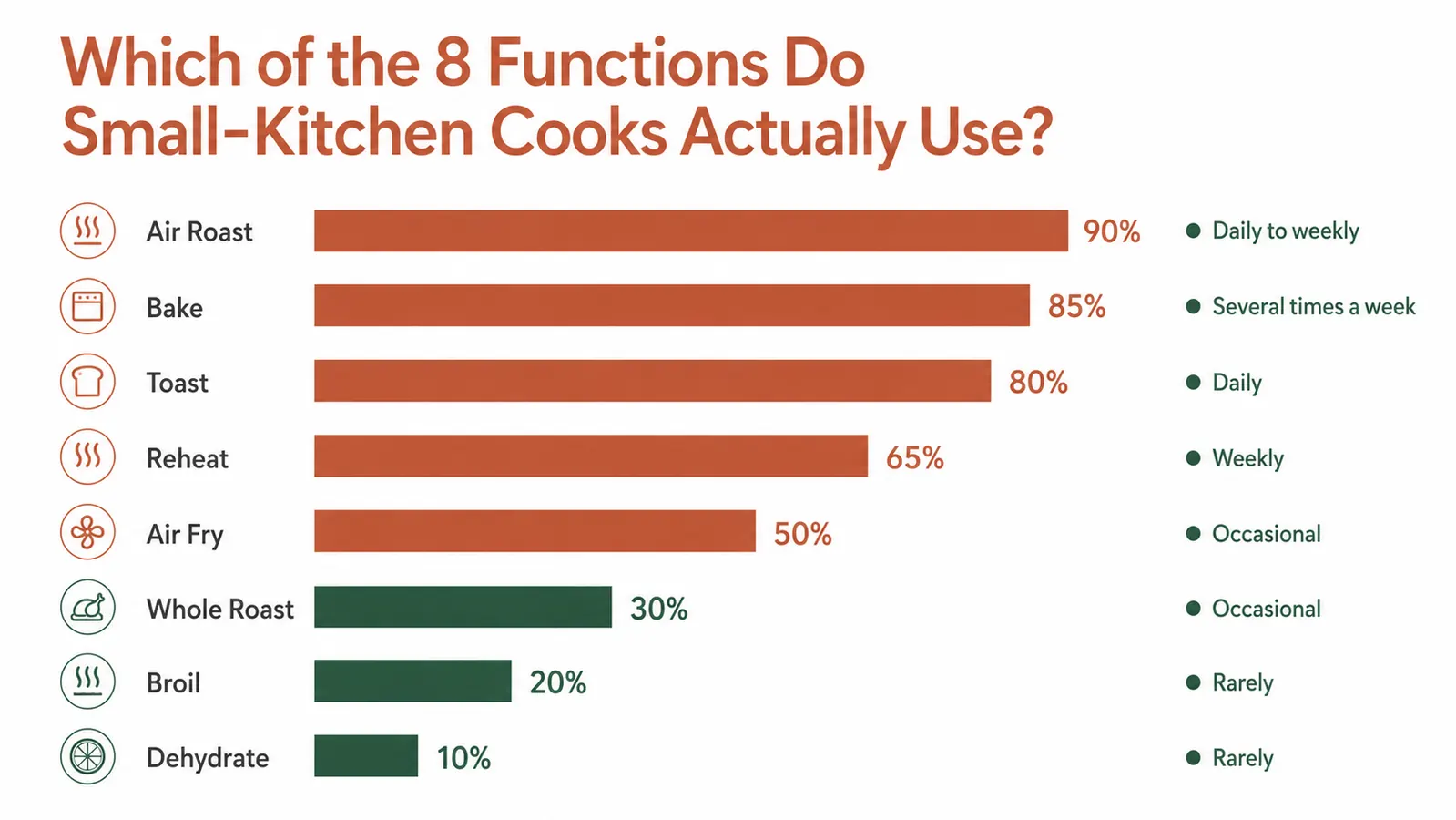
The 8-in-1 Claim: What It Actually Means
Here is the honest chart nobody publishes: of the eight modes, most small-kitchen cooks use three or four regularly and the rest sit untouched for weeks at a stretch. Air Roast, Bake, Toast, and Reheat are the workhorse four. Whole Roast is useful once a month if you buy a small chicken. Air Fry is genuinely functional but is where you will notice the capacity ceiling, which I will get to. Broil is limited in usefulness because the heating element sits at the top and the rack position options are fixed. Dehydrate is a real feature if you make fruit leather or jerky. I used it twice in six months.
None of that is a criticism of the design. It is just an honest adjustment to marketing copy that implies you are getting eight appliances in one. You are getting one very good multi-function toaster oven with some modes you will use constantly and some you will use occasionally. If you already know that going in, you will not feel shortchanged. If you buy expecting to retire your air fryer basket, your dehydrator, and your broiler pan all at once, you will be recalibrating expectations in the first week.
The Hidden Trade-Off Nobody Mentions: Overhead Clearance
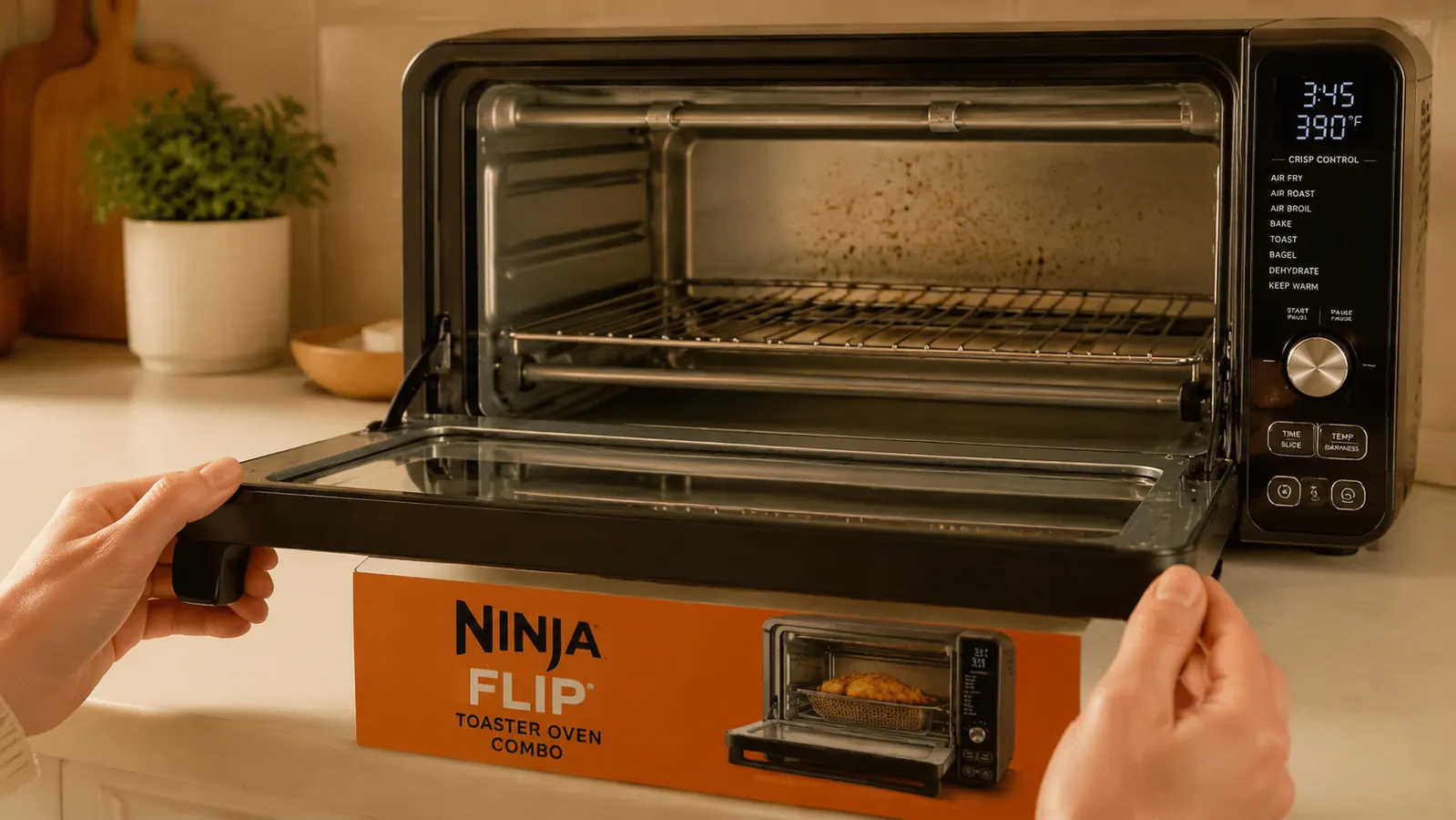
Every review mentions that the Ninja Flip's door opens upward instead of outward, freeing up the counter space in front of the unit. That is accurate and it is genuinely useful. What those reviews skip is the flip side: when that door is raised, it extends roughly 12 to 13 inches above the top of the oven body. If you have an overhead cabinet or shelf within 13 inches above the unit, the door will not open fully. I learned this by nearly clipping my cabinet hinge on day one.
In my setup, the Ninja Flip lives on my counter below a cabinet that sits about 16 inches above it. That gave me just enough clearance, about 3 inches to spare. If you have tighter overhead clearance, measure before you buy. The gain in front-clearance is real. The overhead requirement is the trade-off the box does not highlight. For a machine sold specifically to people in small kitchens with tight overhead cabinet spacing, that is an omission worth knowing.
The door that frees your counter space in front also needs 13 inches of clearance above the oven. In a tight kitchen, measure your overhead cabinet height before you buy.
Noise: The Air Fry Mode Surprise
The Ninja Flip is not a quiet appliance in air fry or air roast mode. The convection fan runs at a level I would describe as noticeable rather than loud, somewhere between a bathroom exhaust fan and a box fan on medium. In a small apartment kitchen where the living area is seven feet from the oven, you will hear it clearly when it is running. This is not unusual for a convection-based appliance, but if you have become used to a conventional toaster oven's near-silence, it is a real adjustment.
The fan also cycles on and off as the oven regulates temperature in bake mode. So even when you are not in a convection mode, you will hear occasional short bursts. This happens about three to four times during a standard 20-minute bake cycle in my experience. Again, not a dealbreaker, but if you work from home at a desk right next to your kitchen and silence matters to you, know it is there.
The Cleaning Reality After Six Months
Toaster ovens get dirty. That is not a Ninja-specific issue. But the interior of the Ninja Flip has some geometry that makes cleaning slightly more involved than a conventional unit. The heating elements run along the top of the interior, and because air roasting circulates fat-laden air at high temperature, the top surface and the rear wall accumulate grease buildup faster than you might expect. After a session of air-roasting chicken thighs, I wipe the interior walls and top within an hour while it is still warm. If I skip that and let the grease cool, it takes real effort to remove.
The included baking pan and wire rack are dishwasher safe, which is a genuine convenience. The oven interior is not, so the wipe-down habit is non-negotiable if you want it to perform consistently and not smoke during preheat. After about two months of regular air roasting, I started doing a deeper clean with a paste of baking soda and water on the rear wall and ceiling of the interior about once every three weeks. If you are not a person who enjoys appliance maintenance, factor that in before deciding whether the air-roast function gets used often enough to justify the purchase.
The Top Surface Heat Issue
The top surface of the Ninja Flip gets genuinely hot during operation. Hot enough that you cannot rest a dish or a hand on it while it is running. This matters in a small kitchen for a specific reason: it is common to stack things on top of appliances when counter space runs out. Do not stack anything on this unit while it is on, and think carefully about what you store directly above it in any cabinets. The heat rises, and over time that will affect adhesive shelf paper, wood laminate undersides, and anything heat-sensitive stored in an overhead cabinet above the unit.
I moved my spice rack from the cabinet above the oven to a wall-mounted magnetic strip on an adjacent wall after the first month. The cabinet above the unit is now reserved for the Ninja's own pan, rack, and a folded silicone oven mitt. Nothing that can be damaged by intermittent heat exposure. If your kitchen layout means the oven has to go under active storage, build in that consideration.
Air Fry Capacity: The Real Ceiling
The Ninja Flip's air fry capacity is not the same as a dedicated 4-quart or 5-quart basket air fryer. This unit uses a flat wire rack rather than a basket, and for air frying to work well the food needs to sit in a single layer with space around each piece. That means in practice you can air fry about two servings of chicken pieces, a single serving of fries from frozen, or a few handfuls of Brussels sprouts at one pass. For one person that is usually enough. For two people eating different things, you are running two cycles back to back.
For detailed notes on what this means for side-by-side buying decisions, I cover it fully in the Ninja Flip vs Breville Compact comparison. The short version: if frying large batches is your primary use case, the Ninja Flip's toaster oven format is not the better choice compared to a dedicated basket fryer at the same price point. If frying is a secondary function and baking, toasting, and air roasting are your daily drivers, the Flip's capacity is fine for a one-to-two-person household.
What the $160 Price Tag Is Actually Buying You
I spent time with this question because it bothered me for the first few weeks. Here is the honest breakdown. You are not paying for eight appliances. You are paying for three things: a genuinely good convection oven that produces noticeably better results than a coil-element toaster oven in the same size class, a flip door design that solves a real spatial problem for people with tight counter-to-open-space constraints, and Ninja's quality level, which across my experience with their products means the heating performance stays consistent past the first six months.
If you already own a capable air fryer and a functional toaster oven and are eyeing the Ninja Flip to consolidate them, the math depends on how often you want both functions and how much your counter space costs you. I outline exactly those calculations in the 10 reasons a flip toaster oven is the smart small kitchen upgrade piece if you want to think it through before buying.
If you are coming from a budget toaster oven and want an upgrade that also adds real air roasting capability, the jump from $40 to $160 is significant but defensible for a daily-use appliance. I did not regret it after month two. I stopped second-guessing it completely around month four when I realized I had not turned on my apartment oven in six weeks.
What I Liked
- Convection heat quality is genuinely superior to coil-element competitors at the same size
- Flip door recovers 10 inches of front counter clearance in active use, a real difference in a galley kitchen
- Air roast and bake modes produce consistent results for a one-to-two-person household
- Dishwasher-safe pan and rack make daily cleanup fast
- 4.6-star average across 29,555 reviews signals consistent performance across units, not just lucky samples
- Analog dials work with greasy hands and never glitch
Where It Falls Short
- Overhead clearance needed for flip door is not disclosed prominently; measure your cabinet height before buying
- Convection fan is audible in an open-plan small apartment, not loud but noticeable
- Interior grease buildup after air roast sessions requires discipline about wipe-down after each use
- Top surface heat eliminates stacking and affects what can be stored in the cabinet directly above
- Air fry capacity on the flat rack is limited to one to two servings, not a substitute for a basket fryer for large batches
- Premium price requires an honest match with your actual cooking habits to justify it
Who This Is For
The Ninja Flip earns its price for the small-kitchen cook who bakes and air-roasts regularly, has front counter clearance constraints but at least 16 inches of overhead cabinet clearance above where the oven will sit, and is cooking for one or two people most of the time. If you have been tolerating a weak toaster oven because you thought all toaster ovens were basically the same, this is the model that will change your mind. The convection performance alone is a meaningful quality upgrade. The flip door on top of that is a genuine spatial improvement, not a marketing feature.
Who Should Skip It
Skip the Ninja Flip if your overhead cabinet clearance above the planned counter position is less than 15 inches. The door will not open fully and you will resent the machine every day. Also skip it if your primary cooking use case is toast and reheating only, because you do not need to pay for convection performance you will not use. A basic four-slot toaster oven at a fraction of the price does those two jobs fine. And skip it if you are planning to use it as your primary air fryer for entertaining or batch cooking. It is a capable combo unit for everyday small-household cooking. It is not a party air fryer.
Ran through all six trade-offs and the Flip still makes sense for your kitchen?
The Ninja Flip Toaster Oven is rated 4.6 stars by more than 29,000 buyers on Amazon. Prices on this model fluctuate, so it is worth checking the current price before you decide. If it is under $150 when you check, that is a strong value for what you get.
Amazon Check Today's Price on Amazon →