
If you have about 10 inches of counter width and a real cooking habit, you have probably wondered whether a mini food chopper is worth it. I have wondered it too. I live in a 480-square-foot apartment in Brooklyn, my counter runs 28 usable inches, and every appliance I bring home has to justify its footprint within 30 days or it goes. That is the test I ran on both the Hamilton Beach 3-Cup Food Processor and the Ninja 200-Watt Food Chopper over eight weeks of actual cooking. Same garlic, same onions, same hummus batch, same cleanup routine.
Short answer: the Hamilton Beach wins for anyone who cooks with it more than twice a week. The Ninja wins if you want something that disappears completely and you rarely need it. But there is more nuance than that, because the price gap between them is genuinely small and the performance gap in daily use is larger than I expected. Here is everything you need to make the call.
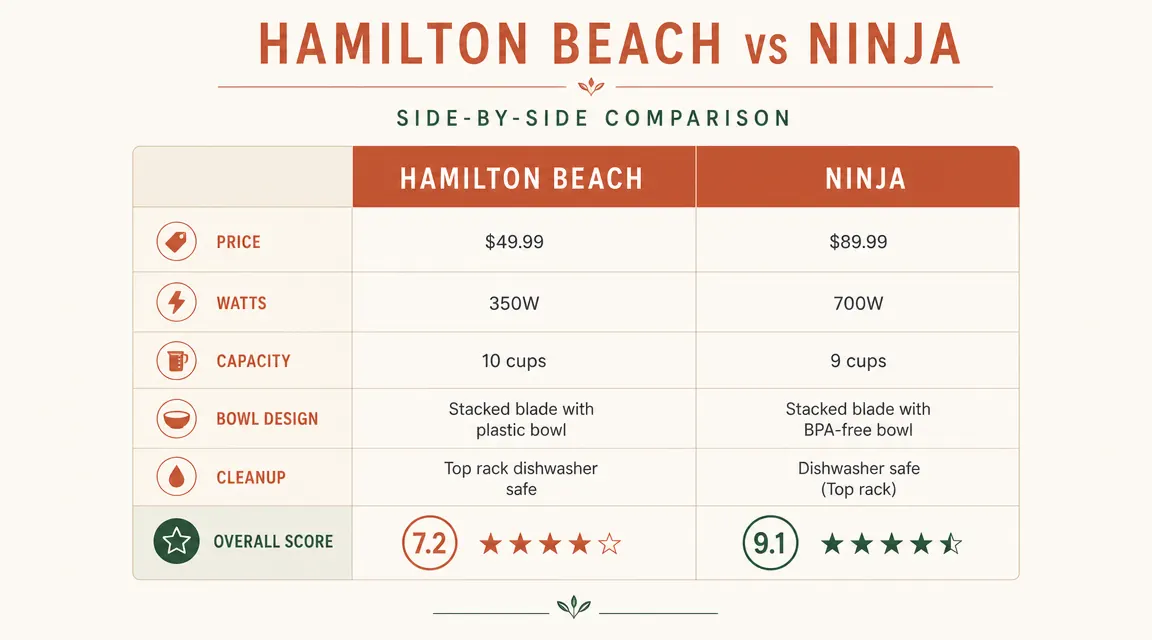
| Spec | Hamilton Beach 3-Cup | Ninja Food Chopper |
|---|---|---|
| Price | ~$22 | ~$28 |
| Motor | 350 watts | 200 watts |
| Bowl Capacity | 3 cups | 2 cups |
| Bowl Material | BPA-free plastic, pour spout | BPA-free plastic, no pour spout |
| Blade Design | S-blade, reversible | S-blade, fixed |
| Storage Footprint | Compact, stackable disassembled | Very compact, fewer pieces |
| Cleanup | 3 pieces, top-rack dishwasher safe | 2 pieces, top-rack dishwasher safe |
| Noise Level | Moderate | Moderately loud |
| Rating (Amazon) | 4.6 stars / 36,000+ reviews | 4.5 stars / 20,000+ reviews |
Under $22 and it outmuscles the competition by 150 watts
The Hamilton Beach 3-Cup Food Processor has a 4.6-star rating from over 36,000 buyers. At the current price it is hard to argue with. Check today's price before it changes.
Amazon Check Today's Price on Amazon →Where Hamilton Beach Wins
Motor power is the first place the Hamilton Beach pulls ahead. At 350 watts versus the Ninja's 200 watts, the difference is not abstract. I ran a batch of raw carrots through both machines. The Hamilton Beach took seven seconds and produced even, fine pieces. The Ninja took closer to 15 seconds, produced uneven chunks, and required me to scrape down the sides twice. For soft ingredients like herbs, cooked onions, or ripe tomatoes, the Ninja keeps up. The moment you ask it to tackle anything fibrous or dense, the Hamilton Beach is simply doing the work the other machine struggles with.
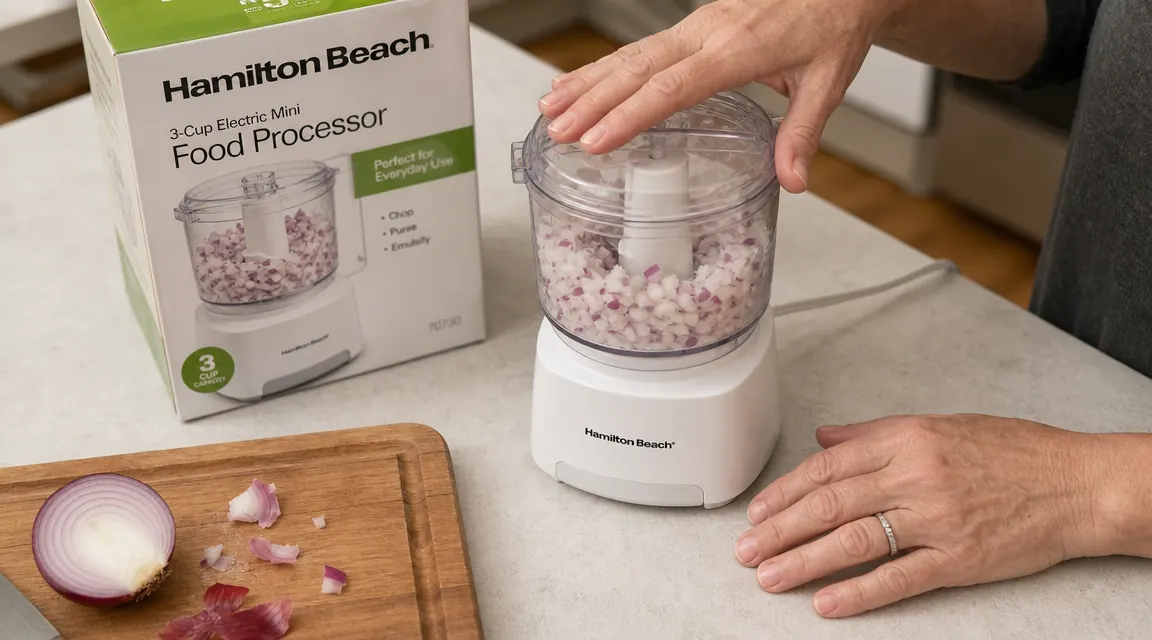
The 3-cup bowl is the second meaningful advantage. One cup more sounds trivial until you are making a full batch of hummus for two people or a double portion of salsa for the week. With the Ninja's 2-cup bowl I had to run the machine twice for anything beyond a single serving. That adds time, adds dishes, and adds the kind of small friction that makes you reach for the knife instead of the machine. The Hamilton Beach bowl also has a pour spout, which turns out to matter when you are draining liquid from chopped tomatoes or adding oil in a thin stream. The Ninja bowl has no pour spout, so you tip and hope.
Where Ninja Wins
The Ninja has fewer parts. That is a genuine advantage if you use it infrequently and want the fastest possible cleanup. Two pieces into the dishwasher and you are done. The Hamilton Beach has three pieces, which is still very fast, but the Ninja edges it on pure simplicity. For someone who uses a chopper once or twice a week, just for garlic and shallots, that simplicity is meaningful.
The Ninja is also slightly more compact when stored. The dimensions are close, but the Ninja's single-piece motor base and smaller bowl take up a little less drawer space. If you are storing this in a utensil drawer rather than a cabinet shelf, that extra cubic inch genuinely registers. I will not oversell this advantage because we are talking about a difference you measure in fractions of inches. But in a 28-inch-counter kitchen, fractions of inches are exactly what I am counting.
The Ninja disappears into a drawer better. The Hamilton Beach does the actual work better. Which matters more depends entirely on how often you cook.
The Cleanup Reality Check
Both machines are top-rack dishwasher safe and both rinse reasonably clean under running water. The Hamilton Beach bowl has a pour spout that creates a small ledge where garlic paste can hide, and you need to hit it with a brush once a week or so. The Ninja bowl is simpler in cross-section and rinses slightly faster. Neither machine gave me a cleanup headache. The Hamilton Beach blade is reversible, which means it has a slightly more complex seating mechanism, but I never found it confusing. Both blades are sharp enough that I handle them with a kitchen towel, not bare fingers.
One honest note on the Hamilton Beach: the lid seal works well but requires a firm press-and-twist to seat correctly. The first week I used it I second-guessed the seal twice because I did not feel confident it was locked. After three days of repetition it became automatic. It is not a flaw, just a learning curve that lasts about as long as it takes to make your third batch of guacamole.
Performance Head-to-Head: Five Real Tasks
Garlic: Both machines are excellent and fast. A four-clove batch takes under five seconds in either machine. Tie. Onions: Hamilton Beach produces more even, fine dice in one pass. Ninja requires a scrape-down and a second pulse. Advantage Hamilton Beach. Hummus (from canned chickpeas): Hamilton Beach handles a full can in one batch with smooth results. Ninja required two batches and still left the texture slightly coarser. Advantage Hamilton Beach. Fresh herbs: Both machines work well and neither bruised the herbs more than the other. Tie. Hard cheese (a small chunk of Parmesan): The Ninja stalled briefly and required two rest-and-retry pulses. The Hamilton Beach moved through it steadily. Advantage Hamilton Beach. Final score: Hamilton Beach wins three tasks outright, ties two, loses none.
The Ninja's weaker motor is not a problem if your use case is limited to soft ingredients and small batches. If you cook regularly, chop a range of ingredients, or batch-prep on weekends, the Hamilton Beach handles the full spectrum without the frustration of mid-task interruptions.
Who Should Buy Which
Buy the Hamilton Beach 3-Cup Food Processor if you cook at home more than three nights a week, you batch-prep on weekends, or you want one machine that handles everything from herbs to carrots to hummus without fussing. At around $22, it costs less than the Ninja and does more. The 4.6-star rating from over 36,000 buyers is earned. I have used mine almost daily for months and it has not slipped a gear, stripped a blade, or cracked a bowl. For a small kitchen where you want a reliable chopper that stores easily and punches above its weight, this is the one.
Buy the Ninja Food Chopper if you live alone, chop soft ingredients only, and want the absolute simplest cleanup with the fewest parts. It is fine for what it does. But understand the trade-off going in: you are paying slightly more for slightly less motor and slightly less capacity. If that combination works for your cooking habits, the Ninja is not a bad machine. It is just a narrower machine.
36,000 small-kitchen cooks gave it 4.6 stars for a reason
The Hamilton Beach 3-Cup Food Processor is the practical pick for anyone who actually cooks. More watts, more capacity, lower price. Check today's price on Amazon.
Amazon Check Today's Price on Amazon →